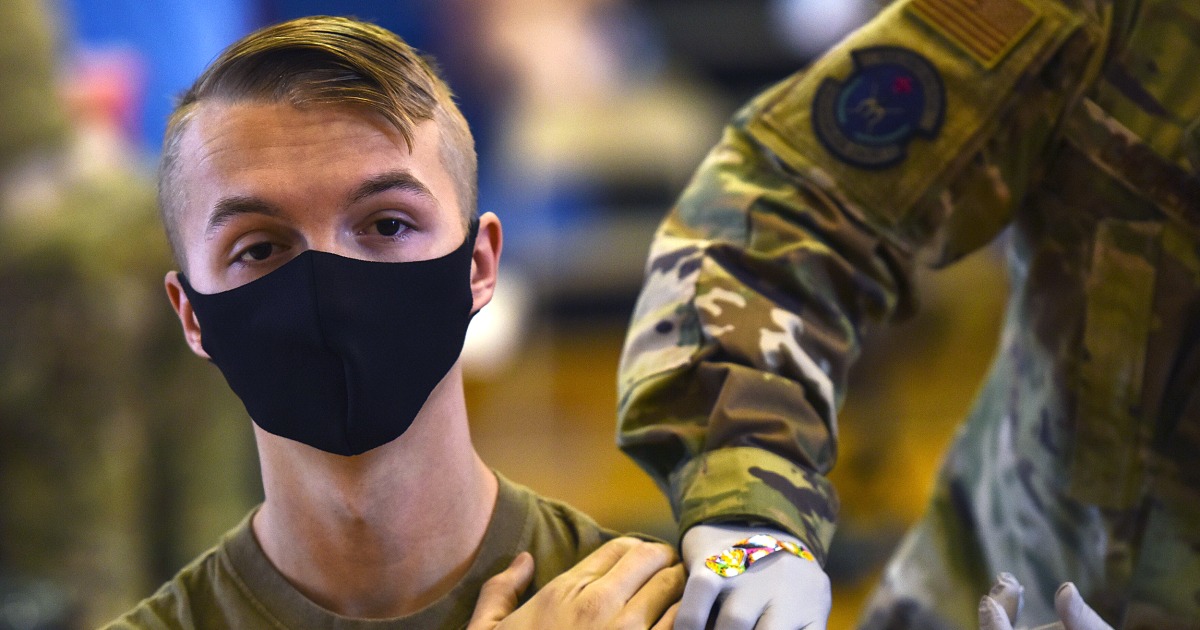
WASHINGTON– By the thousands, U.S. service members are refusing or postponing the Covid-19 vaccine as disappointed leaders scramble to tear down web reports and find the right pitch that will persuade troops to get the shot.
Some Army units are viewing as few as one-third accept the vaccine. Military leaders looking for responses believe they have identified one potential convincer: an imminent release. Navy sailors on ships going out to sea last week, for example, were picking to take the chance at rates going beyond 80 percent to 90 percent.
Air Force Maj. Gen. Jeff Taliaferro, vice director of operations for the Joint Staff, told Congress on Wednesday that “extremely early data” recommends that simply up to two-thirds of the service members used the vaccine have actually accepted.
That’s higher than the rate for the basic population, which a current study by the Kaiser Household Structure put at roughly 50 percent. But the substantial number of forces declining the vaccine is especially uneasy because troops often live, work and battle carefully together in environments where social distancing and using masks, at times, are difficult.
The armed force’s resistance also comes as soldiers are releasing to administer shots at vaccination centers around the nation and as leaders look to American forces to set an example for the country.
” We’re still having problem with what is the messaging and how do we affect individuals to opt in for the vaccine,” stated Brig. Gen. Edward Bailey, the surgeon for Army Forces Command. He stated that in some units just 30 percent have agreed to take the vaccine, while others are in between 50 percent and 70 percent. Forces Command supervises significant Army units, encompassing about 750,000 Army, Reserve and National Guard soldiers at 15 bases.
At Fort Bragg, North Carolina, where several thousand soldiers are getting ready for future releases, the vaccine approval rate is about 60 percent, Bailey said. That’s “not as high as we would hope for front-line workers,” he said.
Bailey has actually heard all the reasons.
” I believe the most entertaining one I heard was, ‘The Army always informs me what to do, they gave me a choice, so I stated no’,” he said.
Service leaders have vigorously campaigned for the vaccine. They have actually held city center, written messages to the force, distributed scientific data, posted videos, and even put out pictures of leaders getting vaccinated.
For weeks, the Pentagon insisted it did not understand how many soldiers were declining the vaccine. On Wednesday they offered few details on their early information.
Officials from private military services, however, stated in interviews with The Associated Press that refusal rates vary extensively, depending on a service member’s age, system, area, implementation status and other intangibles.
The variations make it harder for leaders to identify which arguments for the vaccine are most persuasive. The Food and Drug Administration has permitted emergency usage of the vaccine, so it’s voluntary. But Defense Department officials say they hope that soon might alter.
” We can not make it necessary yet,” Vice Adm. Andrew Lewis, commander of the Navy’s 2nd Fleet, stated last week. “I can inform you we’re probably going to make it necessary as soon as we can, just like we do with the influenza vaccine.”
About 40 Militaries gathered recently in a California conference room for an information session from medical staff. One officer, who was not licensed to publicly go over personal conversations and spoke on condition of anonymity, stated Marines are more comfy positioning questions about the vaccine in smaller sized groups.
The officer stated one Marine, pointing out a commonly flowed and incorrect conspiracy theory, stated: “I heard that this thing is actually a tracking device.” The medical personnel, stated the officer, rapidly debunked that theory, and pointed to the Marine’s mobile phone, noting that it’s a reliable tracker.
Other regular questions focused on possible negative effects or health concerns, including for pregnant females. Army, Navy and Flying force authorities say they hear much the same.
The Marine Corps is a fairly small service and troops are usually more youthful. Comparable to the general population, more youthful service members are more likely to decline or ask to wait. Oftentimes, military leaders stated, more youthful soldiers say they have had the coronavirus or known others who had it, and concluded it was not bad.
” What they’re not seeing is that 20- year-olds who’ve in fact gotten extremely ill, have actually been hospitalized or pass away, or the folks who seem great however then it ends up they’ve developed pulmonary and cardiac abnormalities,” Bailey said.
One ray of hope has been releases.
Lewis, based in Norfolk, Virginia, stated last week that sailors on the USS Dwight D. Eisenhower, which is operating in the Atlantic, consented to get the shot at a rate of about 80%. Sailors on the USS Iwo Jima and Marines in the 24 th Marine Expeditionary System, who likewise are releasing, had rates of more than 90%.
Bailey said the Army is seeing chances to minimize the two-week quarantine duration for systems deploying to Europe if service members are mainly immunized and the host country agrees. U.S. Army Europe may cut the quarantine time to five days if 70%of the system is immunized, which reward could work, he said.
The acceptance numbers drop off among those who are not releasing, military authorities stated.
Gen. James McConville, the Army’s chief of personnel, utilized his own experience to encourage soldiers to be vaccinated. “When they asked me how it felt, I stated it was a lot less unpleasant than a few of the meetings I go to in the Pentagon.”
Col. Jody Dugai, leader of the Bayne-Jones Army Neighborhood Medical Facility at Fort Polk, Louisiana, stated that up until now discussions at the team level, with 8 to 10 peers, have actually achieved success, and that getting more info helps.
At the Joint Readiness Training Center at Fort Polk, Brig. Gen. David Doyle, has a dual difficulty. As base commander, he should persuade the almost 7,500 soldiers on base to get the shot and he requires to ensure that the thousands of troops that cycle in and out for training exercises are safe.
Doyle stated the approval rate on his base is between 30%and 40%, and that frequently it’s the more youthful troops who decrease.
” They inform me they don’t have high confidence in the vaccine because they think it was done too rapidly,” he stated. Top health officials have actually attested to the security and efficiency of the vaccine.
Doyle stated it appears peers are typically more influential than leaders in convincing troops– a sentiment echoed by Bailey, the Army Forces Command cosmetic surgeon.

No comments:
Post a Comment