As COVID-19 vaccination rates pick up worldwide, people have fairly begun to ask: just how much longer will this pandemic last? It’s a problem surrounded with uncertainties. But the once-popular idea that adequate individuals will eventually acquire immunity to SARS-CoV-2 to block many transmission– a ‘herd-immunity limit’– is starting to look not likely.
That limit is usually possible just with high vaccination rates, and numerous researchers had thought that once people began being vaccinated en masse, herd resistance would permit society to return to normal. The majority of price quotes had placed the limit at 60–70%of the population acquiring immunity, either through vaccinations or past exposure to the infection. However as the pandemic enters its second year, the thinking has begun to move. In February, independent information scientist Youyang Gu altered the name of his popular COVID-19 forecasting design from ‘Course to Round Up Immunity’ to ‘Course to Normality’. He said that reaching a herd-immunity threshold was looking unlikely due to the fact that of factors such as vaccine hesitancy, the development of brand-new versions and the delayed arrival of vaccinations for kids.
Gu is a data scientist, but his believing aligns with that of numerous in the public health neighborhood. “We’re moving far from the concept that we’ll strike the herd-immunity threshold and then the pandemic will go away for excellent,” says epidemiologist Lauren Ancel Meyers, executive director of the University of Texas at Austin COVID-19 Modeling Consortium. This shift shows the intricacies and challenges of the pandemic, and should not eclipse the reality that vaccination is helping. “The vaccine will mean that the infection will begin to dissipate on its own,” Meyers says. But as brand-new versions occur and immunity from infections potentially subsides, “we may find ourselves months or a year down the roadway still fighting the danger, and having to deal with future surges”.
Long-term potential customers for the pandemic most likely include COVID-19 becoming an endemic disease, just like influenza. In the near term, researchers are pondering a new regular that does not include herd immunity. Here are some of the factors behind this frame of mind, and what they mean for the next year of the pandemic.
It’s unclear whether vaccines avoid transmission
The key to herd immunity is that, even if an individual becomes contaminated, there are too couple of susceptible hosts around to maintain transmission– those who have actually been vaccinated or have already had the infection can not contract and spread out the infection. The COVID-19 vaccines developed by Moderna and Pfizer– BioNTech, for example, are incredibly efficient at avoiding symptomatic illness, however it is still unclear whether they protect people from becoming contaminated, or from spreading out the infection to others. That presents an issue for herd immunity.
” Herd immunity is only pertinent if we have a transmission-blocking vaccine. If we do not, then the only method to get herd immunity in the population is to give everybody the vaccine,” says Shweta Bansal, a mathematical biologist at Georgetown University in Washington DC. Vaccine effectiveness for stopping transmission requires to be “pretty darn high” for herd resistance to matter, she says, and at the minute, the data aren’t definitive “The Moderna and Pfizer information look rather encouraging,” she says, however exactly how well these and other vaccines stop individuals from sending the virus will have huge implications.
A vaccine’s ability to obstruct transmission doesn’t need to be 100%to make a difference. Even 70?fectiveness would be “amazing”, states Samuel Scarpino, a network scientist who studies transmittable illness at Northeastern University in Boston, Massachusetts. However there could still be a substantial amount of infection spread that would make it a lot more difficult to break transmission chains.
Vaccine roll-out is irregular
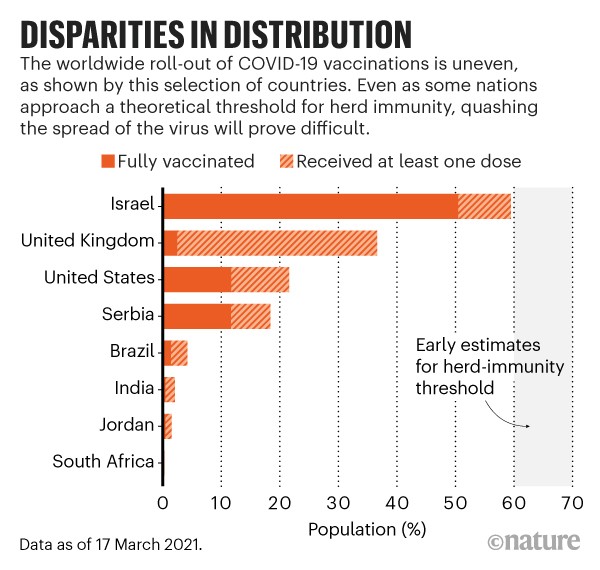
The speed and circulation of vaccine roll-outs matters for numerous reasons, says Matt Ferrari, an epidemiologist at Pennsylvania State University’s Center for Infectious Illness Dynamics in University Park. A completely collaborated worldwide project could have erased COVID-19, he says, a minimum of in theory. “It’s a technically feasible thing, but in truth it’s really not likely that we will achieve that on a global scale,” he says. There are big variations in the performance of vaccine roll-outs between nations (see ‘Disparities in distribution’), and even within them.
Source: Our World In Data
Israel began vaccinating its people in December 2020, and thanks in part to a handle Pfizer– BioNTech to share information in exchange for vaccine doses, it presently leads the world in regards to roll-out. Early in the campaign, health workers were immunizing more than 1%of Israel’s population every day, says Dvir Aran, a biomedical information scientist at the Technion– Israel Institute of Innovation in Haifa. Since mid-March, around 50%of the nation’s population has actually been fully vaccinated with the 2 dosages needed for security. “Now the issue is that young people do not wish to get their shots,” Aran states, so regional authorities are enticing them with things such as totally free pizza and beer. Israel’s neighbours Lebanon, Syria, Jordan and Egypt have yet to immunize even 1%of their respective populations.
Throughout the United States, access to vaccines has actually been uneven. Some states, such as Georgia and Utah, have actually fully vaccinated less than 10%of their populations, whereas Alaska and New Mexico have completely immunized more than 16%.
In most countries, vaccine distribution is stratified by age, with priority offered to older people, who are at the highest danger of dying from COVID-19 When and whether there will be a vaccine authorized for children, however, remains to be seen. Pfizer– BioNTech and Moderna have actually now registered teenagers in scientific trials of their vaccines, and the Oxford– AstraZeneca and Sinovac Biotech vaccines are being evaluated in kids as young as 3. But outcomes are still months away. If it’s not possible to vaccinate kids, a lot more grownups would require to be inoculated to achieve herd resistance, Bansal says. (Those aged 16 and older can get the Pfizer– BioNTech vaccine, but other vaccines are approved just for ages 18 and up.) In the United States, for example, 24%of people are under 18 years old (according to 2010 census information). If most under-18 s can’t receive the vaccine, 100%of over-18 s will need to be vaccinated to reach 76%resistance in the population.
Another essential thing to think about, Bansal states, is the geographical structure of herd resistance. “No community is an island, and the landscape of resistance that surrounds a community truly matters,” she says. COVID-19 has taken place in clusters throughout the United States as an outcome of individuals’s behaviour or regional policies. Previous vaccination efforts recommend that uptake will tend to cluster geographically, too, Bansal adds. Localized resistance to the measles vaccination, for instance, has led to little pockets of disease resurgence. “Geographic clustering is going to make the course to herd immunity a lot less of a straight line, and basically indicates we’ll be playing a game of whack-a-mole with COVID break outs.” Even for a nation with high vaccination rates, such as Israel, if surrounding nations have not done the very same and populations have the ability to mix, the potential for brand-new break outs stays.
New versions change the herd-immunity equation
Even as vaccine roll-out prepares face distribution and allowance obstacles, brand-new variations of SARS-CoV-2 are sprouting up that might be more transmissible and resistant to vaccines. “We’re in a race with the brand-new variants,” says Sara Del Valle, a mathematical and computational epidemiologist at Los Alamos National Laboratory in New Mexico. The longer it requires to stem transmission of the virus, the more time these versions have to emerge and spread, she states.

Brazil started extensive circulation of Sinovac Biotech’s CoronaVac vaccine in January. Credit: Rodrigo Paiva/Getty
Resistance might not last forever
Computations for herd resistance think about 2 sources of specific immunity– vaccines and natural infection. If infection-based immunity lasts just for something like months, that offers a tight deadline for providing vaccines. Given what is known about COVID-19 so far, “reaching herd immunity through vaccines alone is going to be rather not likely”, he says.

No comments:
Post a Comment